
4 Surprising Signals You Might Have Missed in the Indian Market
Introduction: Beyond the Festive Headlines.
September 2025 closed on a high note, with festive cheer seemingly lifting the Indian market to new milestones. With the Nifty pushing above 25,000 and the Sensex crossing the 82,000 mark, the headline numbers painted a picture of broad-based optimism. But beneath this surface-level rally, a set of deeper, more surprising trends were at play, telling a more nuanced story about the market’s health and future direction. This post uncovers four of the most impactful takeaways from the recent market action that you might have missed.
1. Foreign Investors Sold the Rally, But Domestic Money Stepped In
In a counter-intuitive twist, while the major indices were climbing, Foreign Portfolio Investors (FPIs), also known as FIIs, were significant net sellers. Data shows that FIIs recorded a net equity outflow of about ₹7,945 crore in September. The key insight here is that the market’s strength was cushioned by domestic institutions, which “continued to buy” throughout the month. This dynamic is a powerful signal of the Indian market’s growing maturity and resilience. This isn’t just a temporary cushion; it’s evidence of a structural deepening of the market, where domestic capital is now a primary determinant of market direction, capable of offsetting foreign outflows and supporting valuations.
2. The Green Transition Is No Longer a Distant Dream—It’s a Measurable Force
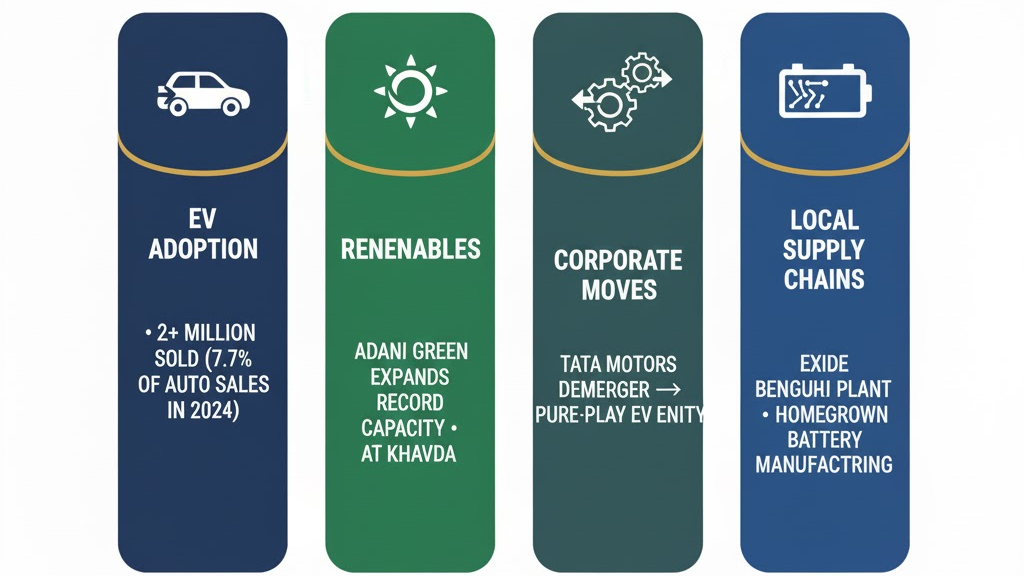
The push for Electric Vehicles (EVs) and renewable energy has moved from a conceptual theme to a powerful growth driver backed by concrete data and significant corporate action. The momentum is now visible and measurable across the ecosystem.
EV Adoption: India’s EV sales have crossed a critical threshold. With over two million units sold in 2024, they now represent a significant 7.7% share of total auto sales, proving consumer acceptance is no longer in doubt.
Renewable Scale: The renewable energy sector is scaling at a record pace, exemplified by Adani Green’s continued commissioning of massive capacity at the Khavda park.
Corporate Clarity: Strategic moves like Tata Motors’ demerger are unlocking value by creating pure-play businesses, making it easier for investors to analyze and invest in the EV opportunity directly.
Local Supply Chains: The development of a domestic battery supply chain, exemplified by Exide’s Bengaluru plant, is a crucial step towards de-risking the entire ecosystem from global supply shocks and import dependence.
Policy push, fast EV adoption and mega renewable projects are arriving together. This combination is powerful for multi-year growth.
3. The Price of Optimism: This Market Isn’t Cheap
To gauge market valuation, investors often look at the Nifty Price-to-Earnings (P/E) ratio. At the end of September, the Nifty P/E was hovering around 21.8 times. To put that in perspective, this valuation is “a little above the long-term zone near 20 times.”
At these valuations, there is little room for error. The market will demand flawless execution and swiftly punish any company that fails to deliver on its earnings guidance.
“…the market is not cheap and will ask companies to deliver on guidance.”
4. A Simple Litmus Test for Trust: Understanding Promoter Holding
Amid complex financial metrics, promoter holding remains a simple but powerful signal. It tells you how much of the company the founders and the promoter group still own. The core idea is that higher ownership often means the interests of the people running the company are better aligned with those of minority investors. However, investors must also watch for high levels of pledged shares, as this can signal financial distress within the promoter group.
As a general rule of thumb for reading this signal:
60-75%: Often considered a healthy range, showing strong conviction from the founders.
35-60%: A common range, but it requires a closer look at the company’s governance and cash flows.
Under 20%: Can still be a successful investment, especially if management quality is high and institutional ownership is strong.
It’s a crucial piece of the puzzle, but not the whole picture. It’s best used alongside other fundamental checks on earnings quality, balance sheet strength, and promoter share pledging.
“It is a trust signal, not a stand-alone buy or sell trigger.”
Conclusion: Reading Between the Lines
The recent market rally is a complex picture of domestic strength triumphing over foreign caution, forward-looking structural shifts in green energy becoming reality, valuations that demand performance, and the timeless wisdom of simple investor checks. Together, these signals suggest an equity market that is evolving but also demands a more discerning eye from investors. As we look ahead, the key question is whether strong corporate earnings can justify the market’s optimism, even if foreign capital remains on the sidelines. What do you think will give way first?